A tale of three Aussie funds
We’re proponents of managed funds. Several of us began our careers in the funds management industry. Trusting a professional to provide sector or regional diversification continues to create wealth for millions of people around the world since managed/mutual funds took off in the early 1980s.
But there are pitfalls to avoid and Aussie share funds are responsible for some of the most hazardous.

When you part ways with 2% of the assets you invest (remember that 2% might represent 25% of your total return!) you want confidence that the person/team you’re entrusting your money to is worth it. You want them to have ideas. You want them to have conviction.
The trouble is that this conviction looks awfully similar from one manager to the next. By opening the bonnet1 on three of the most popular Australian share funds we can see just how similar they are. Purposefully, we’ve picked three fund companies headquartered in different corners of the globe, each running an Aussie share strategy. Here are their top 10 holdings:
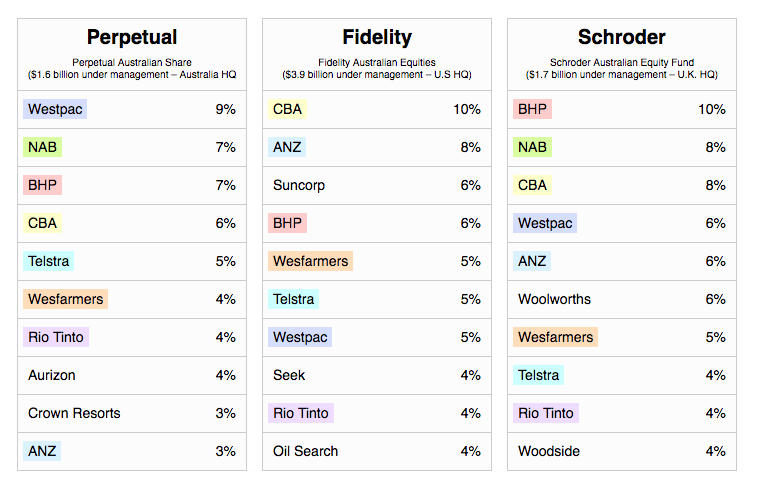
In an equally weighted portfolio of these three funds, 9 of the top 10 holdings are common across all three. The only “outlier” is Woolworth’s, which is held by Schroder and Perpetual.
Of the 30 shares held across the funds’ top 10 positions, 23 are the same.
When you compare these active managers to the index (Vanguard Australian Share ETF), only one (one!) company is not represented by the managers: CSL Ltd.
Basically, this means you’re paying a manager 2% to not buy CSL.
If you’re looking for a dramatic twist, you’ll be disappointed. This isn’t an intriguing tale of nefarious corporate collusion, or even one of lacklustre fund managers. The companies held by these funds, especially the larger positions, are simply some of the most high quality companies in Australia. These are world-class companies. The fund managers are right to hold them. These positions aren’t risky bets on companies from disparate sectors. They’re simply the best representation of the Australian economy.
This isn't a story about holdings, but one about fees. The question is why should you continue to pay a fund manager for ideas that have been public knowledge for years?
These ideas can be easily replicated using a DIY strategy, an mFund (which will hopefully be cheaper), or via an ETF. The Vanguard Australian Share ETF (ticker: VAS) that we used for benchmarking above charges 0.15% per annum.
Assuming you can get an 8% annual return from an Aussie share strategy, you’re giving up 2% of your return versus 25% using a traditional managed fund. And the only sure thing in investing are the fees you pay.
1This data is available from the fund companies' websites.
FURTHER READING


What AI gets wrong about your clients’ portfolios
What ChatGPT and AI assistants miss when evaluating a real investment portfolio, and how advisers can respond. Acknowledge, verify, add context and document.


September top trades: Microsoft bounces back, Apple cools and New Zealanders keep buying
Microsoft buys rebounded, Apple fell from #2 to #12 and New Zealanders bought the most. See what Sharesight investors traded in September 2026.


Product updates - September 2026
See what’s up and what’s down at a glance with our new gains & losses toggle, and more product improvements. It’s all in Sharesight’s September update.