October top trades: Investors buy the AI selloff
October was a rough month for AI stocks. The Nasdaq fell 5.3%, its worst month since March 2025, as investors questioned whether the money pouring into AI will pay off. Chipmakers and data centres took some of the heaviest hits.
Sharesight investors bought in. The share of trades that were buys rose on every chip stock in our top 20 lists, in every market where it appeared in both September and October. In Australia, investors bought the month’s biggest falls and sold into rallies.
That fits a pattern for Sharesight investors. The State of the Australian Investor 2026 report from Morningstar (based on Sharesight data) found investors stayed net buyers through three recent market shocks, with buys outnumbering sells roughly two to one on the busiest trading day of each.
When the chips are down
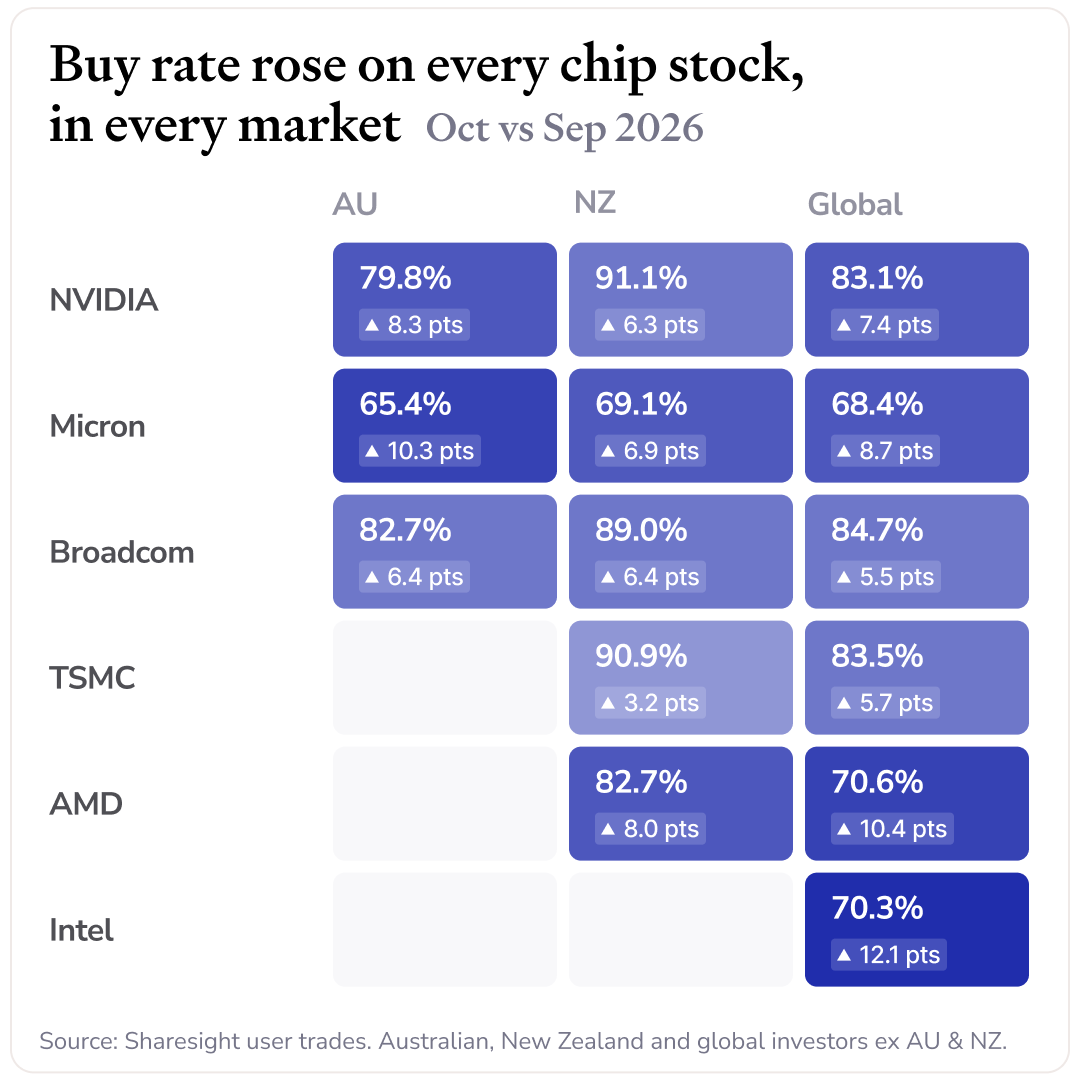
US AI and semiconductor companies lost roughly US$5 trillion in market value during October and Sharesight investors were ready. Across Australia, New Zealand and global markets, chip stocks appeared in the top 20 trades 14 times. Buy rate (the proportion of trades that were buys) rose in all 14.
- Micron (NASDAQ: MU) reported record results on 30 September, with revenue up 379% on a year earlier, and said it had “no line of sight” to the end of the memory shortage. The shares still fell from US$1,097 on 1 October to a US$856 close on 22 October, before rebounding as rival SK hynix reported record results. Micron climbed from #19 to #10 on the most traded list by number of investors in Australia, #16 to #11 in New Zealand and #13 to #7 globally.
- TSMC (NYSE: TSM) beat estimates with its third-quarter results on 15 October, with chairman C.C. Wei calling demand “extremely robust”. The shares fell 3.4% that day on concerns about margins and spending. It rose from #13 to #3 in New Zealand and #16 to #9 globally.
- Broadcom (NASDAQ: AVGO) lined up as much as US$92 billion in chip financing for OpenAI and Anthropic. Its share price fell 3.1% on 14 October after CEO Hock Tan warned financing could limit AI growth. It climbed the top trades list from #15 to #6 in New Zealand.
The month ended badly for chips. Intel (NASDAQ: INTC) fell 28.6% on 30 October, its worst day since 1974, and AMD (NASDAQ: AMD) fell 10.9%. Buy rate for both still rose over the month, though our data can’t show how much of that buying came before the fall.
Grid locked
The AI selloff hit close to home for Australians on 21 October. NextDC (ASX: NXT) fell 41.7% after power supplier Jemena suspended grid works for its M3 Melbourne data centre, and NextDC cut its revenue guidance from A$615-640 million to A$475-500 million.
In a Livewire interview, Charles Story of WaveStone said of NextDC: “Enthusiasm for a theme is not the same thing as an attractive investment at any price”. Australian investors bought anyway. While NextDC didn’t appear in September’s top 20, it claimed #2 spot in October with 77.1% buyers.
Over in New Zealand, Infratil (NZX: IFT), which owns a stake in CDC Data Centres, fell 5.3% on the ASX on 19 October as data centre sentiment soured. On 21 October, it told the NZX that CDC’s power and construction timelines were on track. New Zealanders took Infratil from #10 to #5 on the most traded list with 92.9% buyers.
NVIDIA takes the hat-trick
NVIDIA (NASDAQ: NVDA) was the most traded share for Australian, New Zealand and global Sharesight investors in October. In Australia and globally, it was #1 for the fourth month running. In New Zealand, it climbed from #3 to #1 on the shares list.
The bigger jump came on New Zealand’s list of all instruments, ETFs included. NVIDIA went from #12 to #1, overtaking the Smart US 500 ETF (NZX: USF). It’s the third time this year a single share has led that list, and it’s been NVIDIA each time.
Microsoft (NASDAQ: MSFT), September’s #1 in New Zealand, slipped to #7, even as it reported revenue up 18.8% year on year.
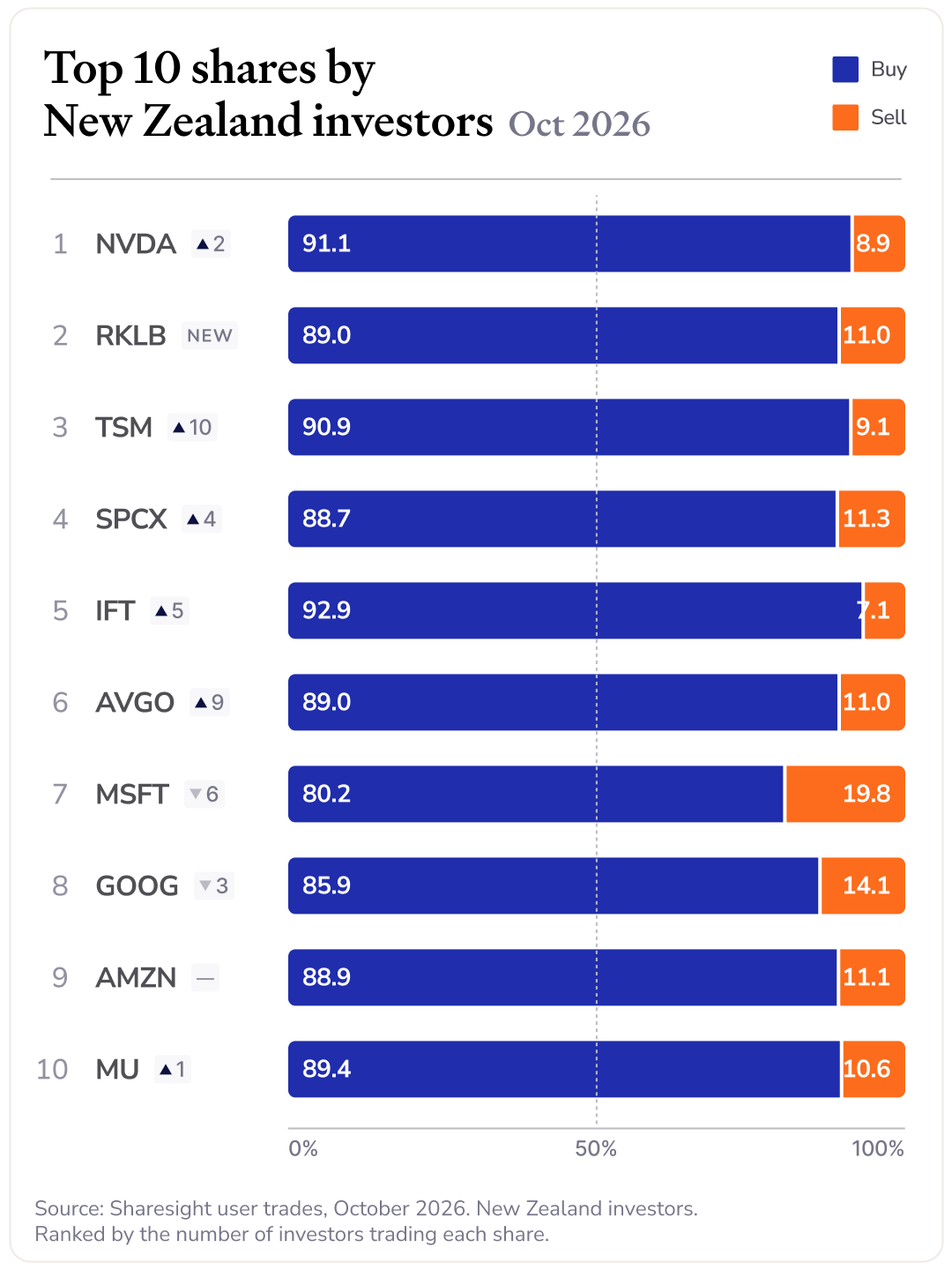
September’s trans-Tasman split held in October. Nine shares made the top 20 in all three markets and, on every one, New Zealanders had the highest buy rate and Australians the lowest. Across those nine, buys averaged 83.9% in New Zealand, 77.0% globally and 71.6% in Australia.
Down? Buy. Up? Bye.
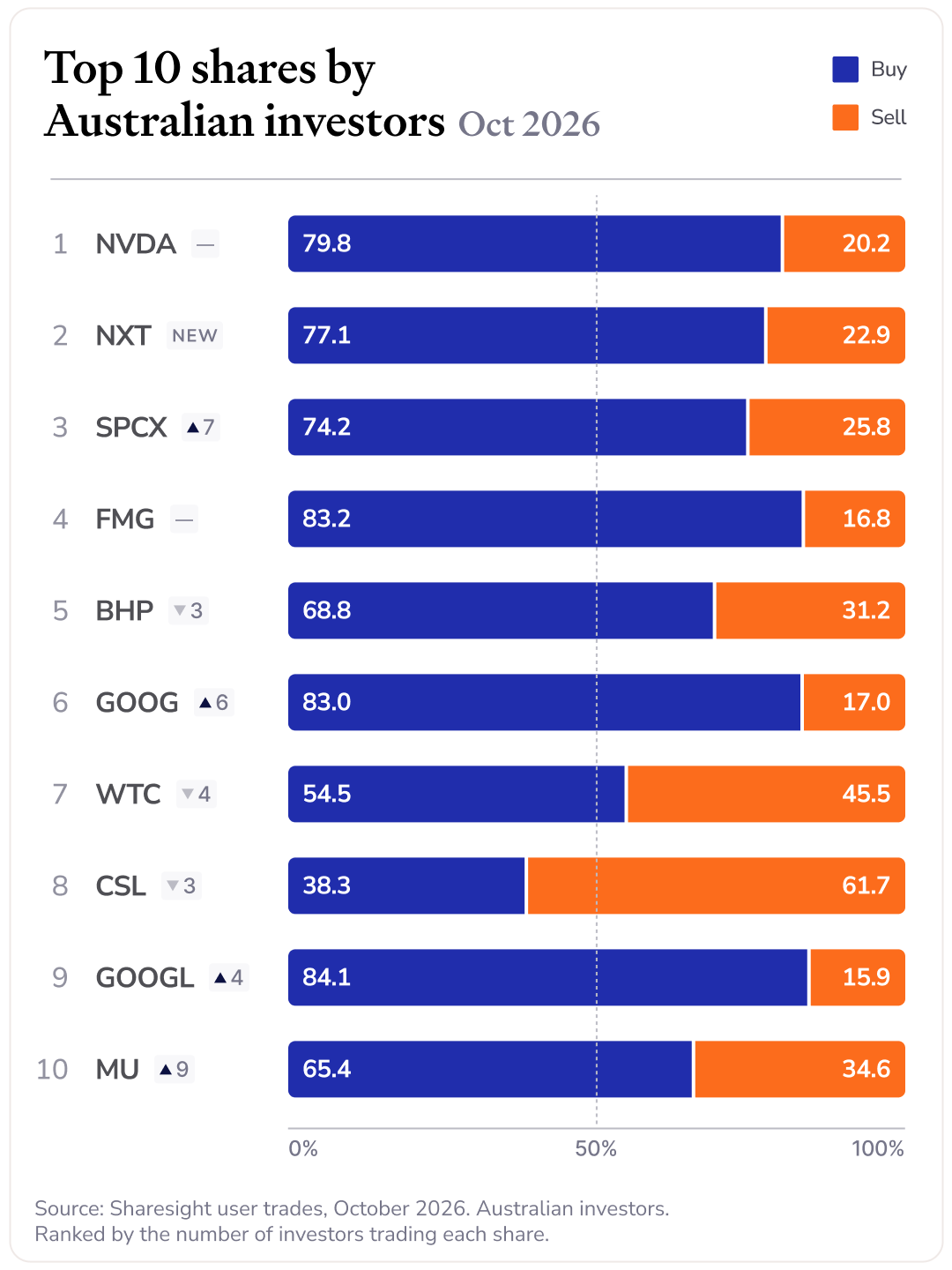
NextDC wasn’t the only fall Australians bought. Fortescue (ASX: FMG) hit a 16-month low of A$14.62 after its first-quarter shipments missed estimates. It held at #4 and its buy rate rose from 78.1% to 83.2%.
Zip (ASX: ZIP) fell as much as 50.5% on 23 October – its worst intraday session to date – after disclosing an external US fraud incident that cost it A$10.1 million. It entered Australia’s top trades list this month at #19, with 60.8% buys.
The shares that rallied went the other way:
- WiseTech Global (ASX: WTC) rose 27.8% over the month to 26 October after ASIC closed two investigations with no action. Its buy rate fell from 71.6% to 54.5% and it slipped from #3 to #7.
- Woodside Energy (ASX: WDS) was up about 8% in October after a turbulent quarter, with crude oil easing slightly to around US$115 a barrel. Australians were net sellers, with 47.7% buyers, and it fell from #8 to #15.
- CSL (ASX: CSL) confirmed its FY27 financial guidance with net profit expected to grow by about 5% after tax, and its shares rose 0.84%. After spending the past two years tumbling to a near 10-year low of A$90 in June, CSL has clawed its way back to above start-of-year levels, closing out October at A$200.73. Australian investors were net sellers for a third month, at 61.7% sells.
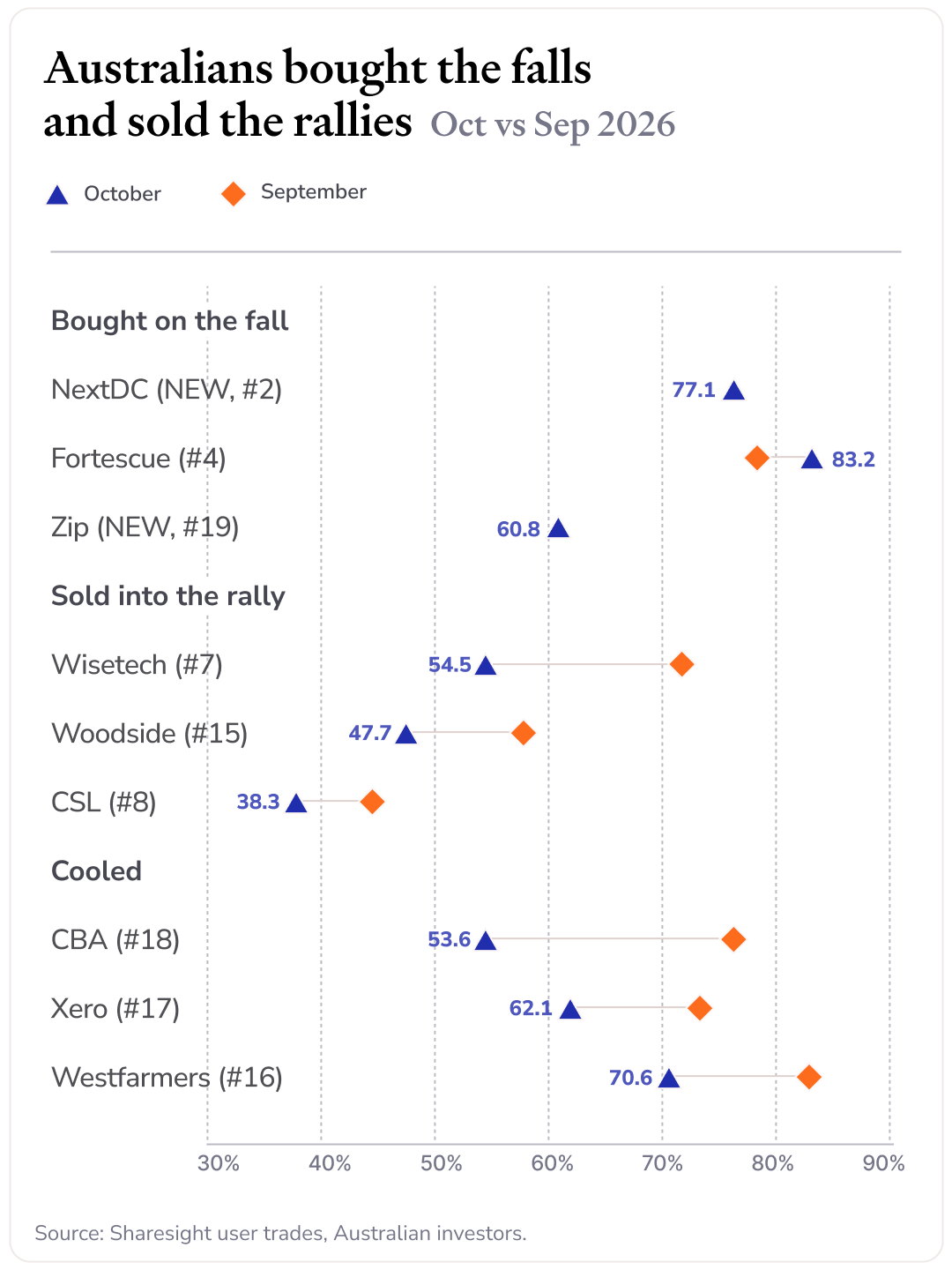
Some local favourites simply cooled. Commonwealth Bank (ASX: CBA) fell from #9 to #18 and its buy rate from 75.8% to 53.6%, Xero (ASX: XRO) fell from #6 to #17, and Wesfarmers (ASX: WES) slipped from #14 to #16.
October’s global movers and shakers
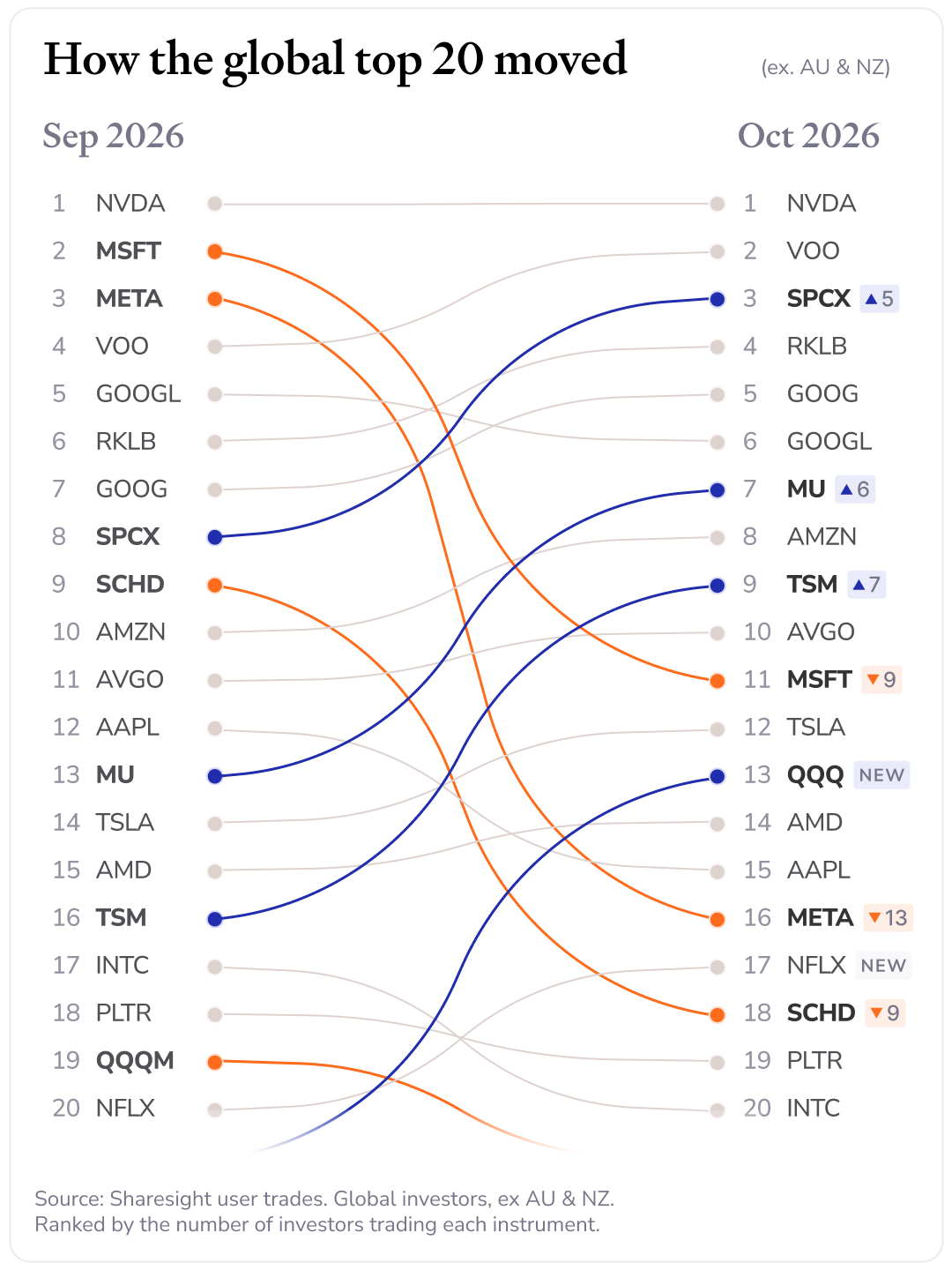
Among global investors, TSMC made the biggest climb, up seven places to #9. Micron moved up six to #7 and SpaceX (NASDAQ: SPCX) up five to #3. Meta (NASDAQ: META) made the biggest fall, dropping 13 places to #16, while Microsoft dropped nine to #11.
Disclaimer: The above article is for informational purposes only and does not constitute a specific product recommendation, or taxation or financial advice and should not be relied upon as such. While we use reasonable endeavours to keep the information up-to-date, we make no representation that any information is accurate or up-to-date. If you choose to make use of the content in this article, you do so at your own risk. To the extent permitted by law, we do not assume any responsibility or liability arising from or connected with your use or reliance on the content on our site. Please check with your adviser or accountant to obtain the correct advice for your situation.


Your complete portfolio performance: Product updates, October 2026
This month we added cash account performance, Australian funds composition data, faster custom investment price imports, and upgraded several reports.


Same foundations, different convictions: how Australian men and women really invest
Sharesight data shows Australian men and women share the same core ETFs – but women lead on ethical investing and buy-and-hold, while men trade more actively.


What AI gets wrong about your clients’ portfolios
What ChatGPT and AI assistants miss when evaluating a real investment portfolio, and how advisers can respond. Acknowledge, verify, add context and document.